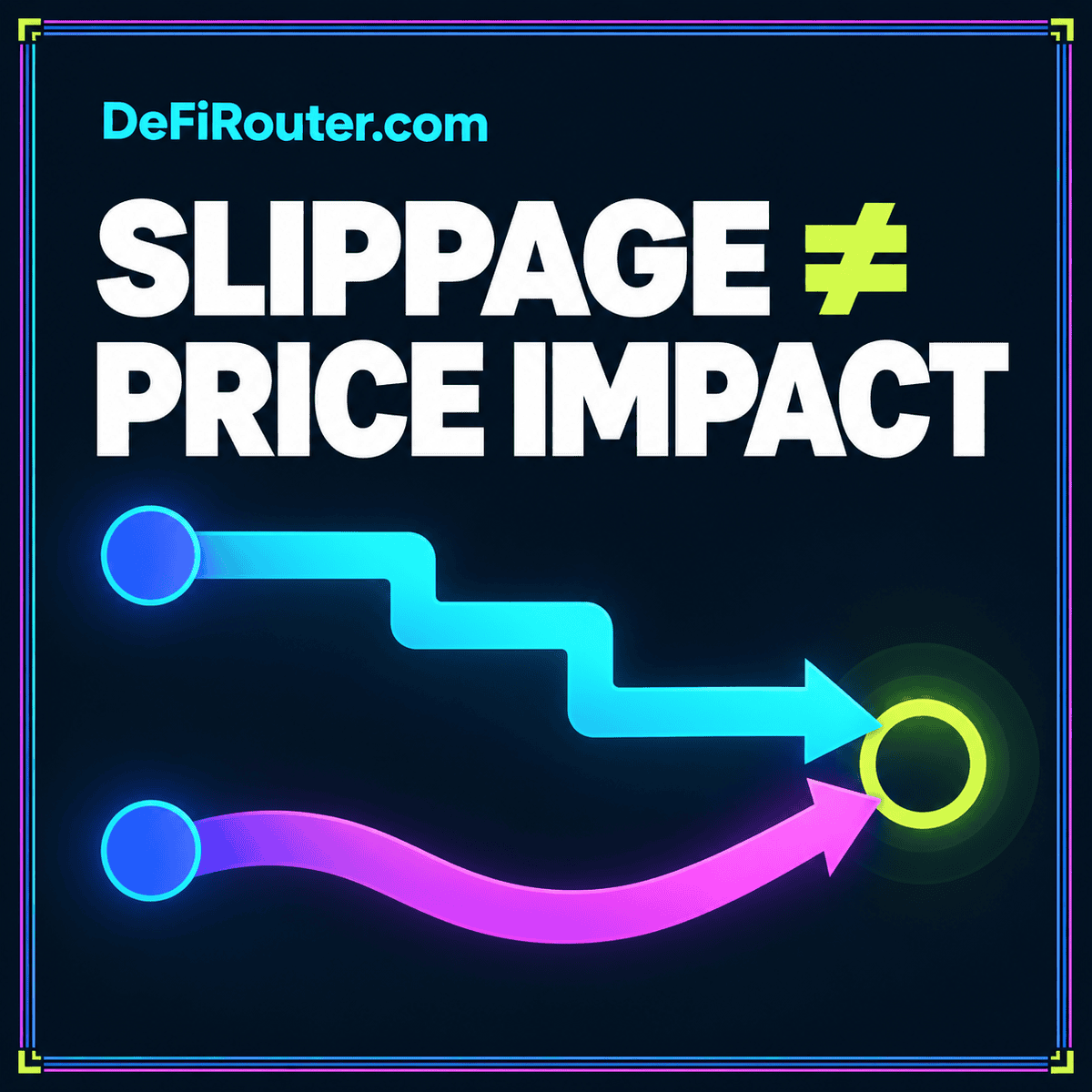
A swap can return fewer tokens than a quick glance at a market price suggests for two different reasons. Your order may change the price available in the liquidity pool. Conditions may also change between the quote and execution. Those effects are called price impact and slippage, and treating them as interchangeable makes a trade harder to evaluate.
The distinction matters before you change a setting. Increasing slippage tolerance does not improve a shallow pool’s liquidity or reverse the price impact already built into a quote. It allows a wider range of execution outcomes. This guide explains the two comparisons, walks through hypothetical arithmetic, and shows how to review the amount you are actually agreeing to receive.
Start with the right comparison
Uniswap Labs distinguishes price impact from price slippage by what causes the change. Price impact comes from your own trade. Slippage measures the difference between the expected result and the result at execution.
For an exact-input swap, keep three amounts separate: an indicative amount at a reference price, the quoted output for your actual order size, and the output you eventually receive. Comparing the first two can help explain price impact. Comparing the last two can help explain realized slippage. Interfaces may use different reference prices or include fees differently, so read the definition attached to each displayed percentage.
A token’s large market capitalization does not tell you how much liquidity is available along your chosen route. The relevant question is how much can be exchanged at prices near the current quote, for this token pair and this order size.
Price impact is part of the route’s economics
In an automated market maker, the terms of the exchange depend on the pool’s reserves and pricing rules. A larger order relative to available liquidity generally moves further along its price curve. The average rate across the whole order can therefore be less favorable than the rate implied by a tiny trade.
A hypothetical pool example
Imagine a simple constant-product pool with 1,000 units of token A and 1,000 units of token B. Ignore every fee, rounding effect, and other trade. Its reserve product is 1,000,000. The starting reserve ratio suggests roughly one B for one A for an infinitesimally small exchange.
If you add 100 A, the pool holds 1,100 A. Keeping the product constant leaves approximately 909.09 B in the pool, so the output is about 90.91 B. Receiving 90.91 B instead of the 100 B suggested by the starting ratio represents approximately 9.09% less output. This is the average execution effect in this simplified example, not a universal formula for every protocol.
Nothing had to happen while the transaction was pending to create that difference. The size of the hypothetical order created it. The quoted 90.91 B would already reflect that effect, so subtracting another 9.09% from the quote would count the same effect twice.
Slippage compares the quote with execution
Now consider a separate hypothetical swap quoted at 1,000 B. If the completed swap returns 995 B, the output is 0.5% below that quote: five divided by 1,000. That five-token difference describes adverse realized slippage under this output-based comparison. If the trade returns more than quoted, execution has improved, although who receives any surplus depends on the service’s rules.
Other trades can change pool reserves while your transaction is pending. Liquidity can change, and the route may encounter different conditions from those used to generate the estimate. A fresh quote narrows the time gap you are evaluating; it cannot freeze the market.
Slippage should also be measured in the correct asset. A wallet’s changing dollar valuation can move even when the number of output tokens does not. Record token amounts first, then use a clearly identified valuation time if you want to compare dollar estimates.
Percentages need a common denominator
Consider another fee-free illustration: a reference amount of 1,000 B, a quote of 980 B, and execution at 970 B. The quote is 2% below the reference. Execution is approximately 1.02% below the quote, because ten divided by 980 is approximately 0.0102. The final result is exactly 3% below the original reference. Simply adding the first two percentages gives a slightly different answer because they use different denominators. Comparing the token amounts preserves the full picture.
Slippage tolerance defines an execution boundary
For a typical exact-input swap, the meaningful boundary is a minimum output amount. A correctly enforced minimum causes the transaction to revert if the swap would deliver too little. For an exact-output swap, the comparable control is a maximum input amount. These are different order types, so make sure you know which side of the exchange is fixed.
Suppose an interface uses a direct percentage reduction from quoted output. With a hypothetical quote of 1,000 B and a tolerance of 0.5%, its minimum would be 995 B. Under that specific convention, 998 B satisfies the boundary and 994 B does not. Some systems derive limits through price-ratio calculations, rounding, or additional rules. Treat the displayed minimum or maximum as the figure to inspect rather than assuming every interface uses identical arithmetic.
The tolerance is not a forecast that the trade will lose that percentage. It is also not a cap on every cost. Network fees, an approval transaction, and already included pool or service fees need separate attention. Our swap cost guide explains how to assemble those pieces without subtracting the same fee twice.
Choose a boundary you can explain
There is no universal slippage percentage that makes every swap sensible. A narrow boundary can lead to more reverts when conditions change. A wider one permits a worse result. Neither setting fixes a route whose starting quote is already unacceptable.
Begin with the minimum number of tokens that would still meet your purpose. Compare that amount with the quote and read the route’s warnings. If the acceptable amount cannot be supported by the available liquidity, changing the tolerance merely to make the transaction succeed changes the economic decision.
When a quote looks unusually poor, review the token contract, network, order size, and route before blaming slippage. A similarly named token, an unsupported asset variant, or a tiny pool can make the wrong comparison look superficially plausible.
Use a consistent review sequence
- Confirm the assets. Check the network and token contracts, including the precise asset you will receive.
- Inspect the actual order size. A quote for a small test amount does not establish the rate available for a much larger swap.
- Read expected and minimum output. Write both in token units and identify which fees are already included.
- Refresh before signing. Reassess the full quote if the amount, route, network fee, or minimum changes.
- Compare with the receipt. After a completed swap, use actual token movements and paid network fees to understand the result.
Splitting an order is not an automatic cure
Dividing a trade among genuinely different liquidity sources can improve its combined rate, but the additional execution can cost more gas. Dividing the same order into several consecutive swaps through the same unchanged constant-product pool does not restore its starting price. Ignoring fees, rounding, and intervening activity, the combined reserve movement still reflects the combined order.
Waiting between smaller orders introduces a different uncertainty: market conditions may improve or deteriorate. Assess that as a change in execution strategy, not a guaranteed discount. Our routing overview explains why a router weighs available liquidity and transaction complexity together.
Keep transaction ordering in view
Some adverse execution comes from how transactions are ordered. A sandwich attack can place trades around a victim’s swap and worsen its result. A generous minimum-output margin can create more room for adverse execution; it should not be treated as harmless because the transaction eventually succeeds.
Services may offer private submission or other protections, each with its own implementation and assumptions. Our guide to MEV and sandwich attacks explains what to investigate. A protection label is not proof that every source of price movement has disappeared.
Read the quote as an agreement
Price impact explains what your order does to available liquidity. Slippage explains what changes between expectation and execution. Keep the reference price, quoted output, minimum output, and completed result separate. Once those figures are clear, you can assess a route on understandable terms rather than hoping that one percentage setting will solve every problem.