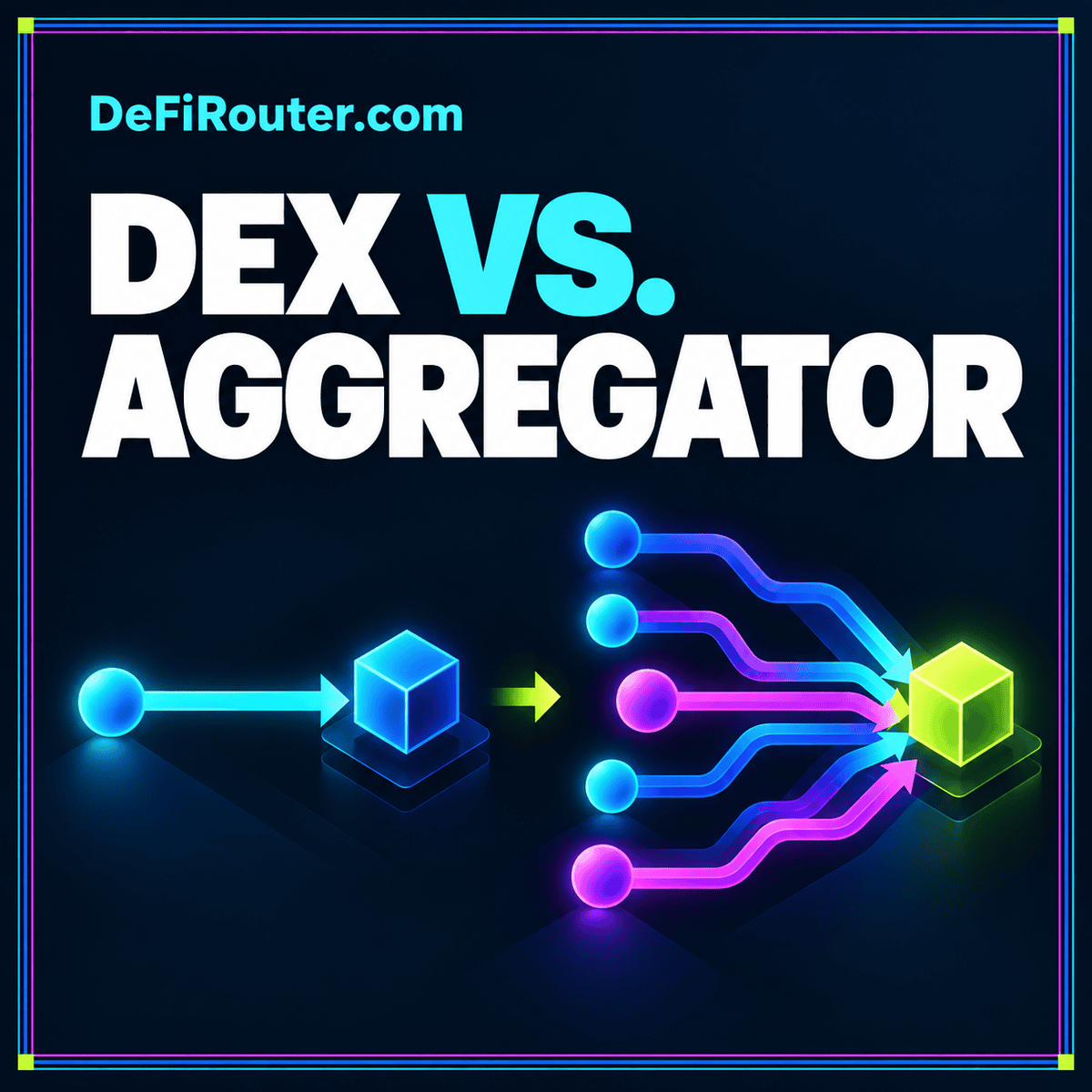
A decentralized exchange supplies a way to trade assets through a particular market mechanism. A DEX aggregator searches liquidity across supported venues and builds a route for a requested trade. In practice, a swap can use both: the aggregator finds the path, while one or more underlying exchanges supply the liquidity that the path consumes.
The distinction is useful because familiar interfaces can hide different execution arrangements. A simple swap box might connect to one protocol, combine several versions of that protocol, or compare multiple independent sources. Instead of choosing by category name alone, examine what the interface actually searches, what it asks you to authorize, and how it explains the result.
A DEX describes a market, not just its website
In an automated market maker, traders exchange against liquidity managed by smart contracts. Other exchange designs use order books or related matching arrangements. Those mechanisms determine how prices respond to trade size and how orders reach available counterparties.
The website is an access point to those mechanisms. Several applications can expose the same underlying protocol, and a branded exchange interface can offer routing features of its own. Consequently, “using one DEX” does not always mean sending the whole trade into exactly one pool.
For example, a protocol can have several pools for a pair, with different fee settings or liquidity distributions. Its interface may compare those pools or use an intermediate asset. That is already a form of routing. The broader routing guide explains direct paths, multiple hops, and split orders before the comparison becomes more technical.
An aggregator adds a search and coordination layer
An aggregator connects a request to its supported liquidity sources, compares potential execution paths, and returns a proposed result. Some paths use a single source. Others split across venues or involve several token conversions. “Aggregator” describes access and coordination; it does not require every trade to be split.
The official 1inch explanation of DEX aggregation describes sourcing liquidity, evaluating routes, and splitting orders when useful. It also distinguishes direct routing from systems in which a user signs an intent that other participants compete to fill. These approaches should be evaluated through their particular settlement rules rather than treated as interchangeable.
Aggregation does not merge every market into one permanent pool. It assembles access to available sources for a specific request. If a source is unsupported, unavailable, excluded, or incompatible with the token, it may not contribute to the result at all.
The differences worth comparing
| Question | Why it matters |
|---|---|
| Which liquidity is searched? | Coverage determines the candidate markets, but more listed sources do not guarantee more useful depth for this pair. |
| How is the route chosen? | A quoted improvement may come from another pool, a split, a private quote, or a different execution model. |
| Which costs are visible? | Pool fees, interface charges, network costs, and approval costs may appear in different parts of the journey. |
| What receives permission? | The spender and transaction destination can differ across products even when the underlying market is shared. |
| What confirms completion? | A quote, signed order, submitted transaction, and settled balance are different milestones. |
This framework avoids an unhelpful contest between labels. Two interfaces in the same category can differ more than a particular DEX interface and a particular aggregator do.
Three hypothetical situations
A small trade in a deep market
Imagine a small trade where a direct pool already offers ample liquidity. Searching other venues might produce only a tiny output improvement. If the alternative route needs more computation onchain, extra gas could exceed that gain. An aggregator that accounts for those costs might choose the direct pool too.
The resulting similarity is useful information. It shows that broader search can confirm a straightforward route. There is no need to interpret a single-source result as evidence that aggregation failed.
A larger trade with fragmented liquidity
Now imagine that the requested amount is large relative to the depth available in any one pool. A route using only one market pushes further into its pricing curve. Dividing the input among genuinely separate pools may improve the combined output sufficiently to justify the added execution work.
In this situation, useful evidence includes the split proportions and the total result for the original amount. A quote for just the first portion does not establish how the complete trade would perform. Nor can several routes that share a bottleneck pool be evaluated as though their liquidity were independent.
An obscure token with limited access
Finally, imagine a token available in only one compatible pool. An aggregator cannot manufacture additional depth simply by listing many unrelated exchanges. Its route may lead to that same pool, decline the request, or reveal unusually poor execution.
The appropriate conclusion is that the available market is limited. An interface showing a price is not evidence that the token can be traded in meaningful size, sold in both directions, or handled safely by every connected contract.
Compare the same request at the same time
A fair comparison fixes the network, verified token identities, input amount, recipient assumptions, and execution model. It also uses quotes generated close enough together that a changing market is less likely to explain the difference. Record the time and any source restrictions.
Then separate the asset output from costs paid elsewhere. In a hypothetical comparison, one interface might show 500 output tokens with a separate network fee; another might show an economic estimate of 498 after converting its network fee into token units. Those labels alone cannot tell you which route transfers more value after all charges.
Write down the expected output, output floor, network estimate, explicit service fees, and any prerequisite approvals. Our cost comparison guide provides a consistent way to line up these items. Where a field is unavailable, record the gap instead of assuming it is zero.
It also helps to keep comparison notes separate from a provider’s marketing labels. A hypothetical note reading “higher output before gas, allowance required, quote expired before review” records more useful evidence than “better exchange.” If a second observation gives a different result, retain both with their conditions. Routing quality is a property of a request and its execution context, so a single observation cannot establish a permanent winner for every asset pair and trade size.
The permission boundary deserves its own review
Direct access and aggregation can involve different contracts, even when they ultimately interact with the same liquidity. Review which component can move the input asset and which component receives the execution instructions. The presence of a recognizable underlying DEX name does not automatically validate an unrelated front end.
Similarly, a noncustodial design does not remove the need to inspect a signature. An allowance or signed order may grant meaningful authority without transferring the full amount immediately. The wording on a button is only a summary of the permission the wallet is being asked to authorize.
Our security checklist covers token identity, contract verification, and approval review. These checks are useful regardless of how many liquidity venues an application can search.
Separate market coverage from chain coverage
A product can support several networks while quoting each network independently. That feature is different from moving value between them. If the input and output are on different chains, the execution needs a cross-chain mechanism and additional status handling.
Ask whether a comparison is between two same-chain swaps or between complete cross-chain journeys. A destination-chain quote that omits the cost, time, or conditions of getting there is not comparable to an end-to-end result. Count the steps the user must actually complete.
A practical way to choose what to inspect
Start with the route you can understand. Identify the underlying markets, inspect the full cost estimate, and confirm that its permissions match your intention. Then compare alternatives with the same inputs. If a claimed improvement cannot be explained in those terms, treat it as an unresolved question rather than a demonstrated advantage.
DeFiRouter.com publishes educational comparisons and simulated examples; it does not rank live quotes or execute trades. The useful takeaway is a method: evaluate the concrete path and the complete transaction experience. Whether the screen belongs to a DEX or an aggregator is the beginning of that evaluation, not its conclusion.