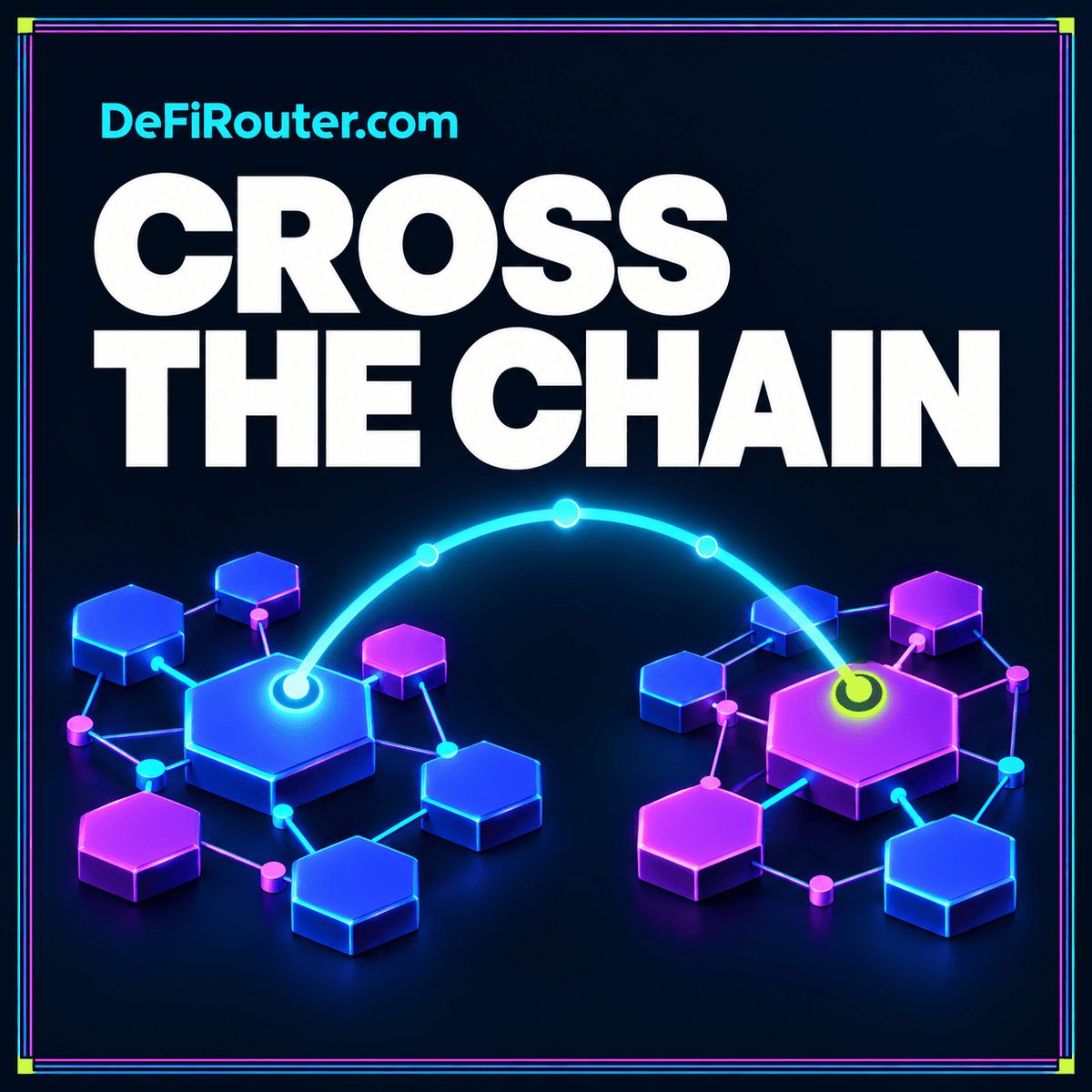
A cross-chain interface can make moving between networks look like an ordinary token swap. Underneath, the journey may require an exchange on the starting network, a bridge or liquidity transfer, and another exchange at the destination. One confirmation screen can represent several dependent stages.
The distinction between a bridge and a cross-chain swap becomes useful when you ask what must happen before the assets are ready to use. Identify the starting asset and network, the exact destination asset, the transfer mechanism, and any actions that remain after arrival. Our cross-chain routing guide introduces these decisions before you compare a specific route.
What each term describes
A bridge connects blockchain environments so that assets or information can be represented or acted on across them. It does not necessarily exchange one economic asset for another. A cross-chain swap describes a broader user objective: exchanging an asset on one network for a specified asset on a different network. The implementation may combine bridging with trading or use a liquidity provider that delivers the requested destination asset.
| Journey | Primary objective | What to inspect |
|---|---|---|
| Same-chain swap | Exchange tokens within one network | Trading route, output, fees, and permissions |
| Bridge transfer | Move value or messages between networks | Verification model and destination representation |
| Cross-chain swap | Receive a chosen asset on another network | Every transfer and exchange needed for completion |
These are useful descriptions, not universal product categories. A service called a bridge may also include swapping. A service called a swap aggregator may rely on a third-party bridge. Examine the route beneath the label.
Identify the destination asset precisely
A matching ticker does not prove that two tokens are interchangeable. Token identity includes the network and contract address, and a destination token may be a wrapped representation with a different issuer or redemption mechanism. Your intended application may accept one representation while rejecting another.
Before choosing a route, check the destination application's documentation and the token issuer's supported addresses. Ask whether you will receive the asset the next step actually requires. Also distinguish a network's native gas currency from an ERC-20 wrapped version of that currency. A wallet can hold valuable tokens while still lacking the native asset needed to submit an ordinary transaction.
Address compatibility deserves the same attention. Similar address formatting across networks does not prove that a receiving service supports the destination chain. Exchange deposits and smart-contract wallets can have additional requirements. Verify the recipient's support before committing funds.
Follow a hypothetical route from start to finish
Suppose you hold 500 units of fictional token ALPHA on Network A and want token BETA on Network B. One route might first swap ALPHA into an asset supported by a bridge, transfer that asset, and then exchange it for BETA. Another route might use a solver that accepts your input conditions and delivers BETA from its own destination inventory.
Both routes aim at the same visible result, but they can have different fees, dependencies, and failure states. The first could complete the transfer while leaving a destination swap unfinished. The second could depend on a solver accepting the quoted economics and meeting its fill conditions. Neither description alone tells you which route is preferable.
Write the objective in concrete terms: the exact recipient receives at least a specified amount of BETA on Network B under clearly stated conditions. Then compare each proposal against that objective, including what happens when only some stages finish.
Understand the transfer mechanism
Some bridge designs lock an asset on one network and issue a representation on another. Other systems burn a token before minting its counterpart elsewhere. Liquidity-based mechanisms can deliver already available assets at the destination, with accounting and settlement occurring through a separate process. Each model raises different questions about backing, verification, and availability.
The Ethereum bridge documentation outlines bridge models and their associated risks. Use those categories to ask who or what confirms the source event, what authorizes release or issuance at the destination, and which system ultimately secures the claim.
A simple interface does not remove these dependencies. Conversely, counting the number of screen clicks is a poor way to estimate security. The meaningful review follows the assets and messages through the actual contracts and participants.
Distinguish arrival from settlement and finality
A source transaction can confirm before a destination transfer is ready. A relayer or solver may front its own funds so that the recipient receives assets before the provider is reimbursed. That produces a fast user-visible fill without making all underlying settlement immediate.
Some canonical withdrawal routes require proving a withdrawal and waiting through a challenge process before finalization. The requirements depend on the particular networks and bridge design. Check the current documentation for the exact direction you intend to travel: depositing into a network and withdrawing from it can have different steps.
Read timing estimates as estimates unless the route provides a specific enforceable commitment. Network congestion, verification delays, unavailable liquidity, or operational interruptions can affect completion. An interface that says “source complete” may be accurately describing one stage while the overall journey remains unfinished.
Compare the full cost of usable funds
A cross-chain quote may include trading fees, bridge fees, liquidity or relayer charges, and an application fee. Network costs can appear separately on the source chain, the destination chain, or both. Some routes incorporate a destination execution cost into the quoted amount; others require another transaction paid by the recipient.
Imagine two hypothetical routes that quote 490 and 488 destination units from the same input. The larger number is only better economically if the amounts describe the same asset and include comparable remaining costs. If the first route still needs a paid claim and another swap, the initial comparison is incomplete.
Record what is included, what remains payable, and which assets pay each fee. Include any approval expense and the cost of obtaining destination gas. Our swap cost guide provides a framework for comparing the final usable output rather than one isolated headline number.
Map the additional dependencies
A cross-chain journey can depend on multiple smart contracts, both networks, a message verification system, liquidity providers, relayers, and software coordinating the route. Some components may be upgradeable or controlled by administrative keys. A useful review asks which participants can pause, change, censor, or authorize part of the process.
Audits and operational history contribute evidence, but neither guarantees that all future conditions are covered. Likewise, labels such as “decentralized,” “trustless,” or “non-custodial” need a specific explanation of what is trusted and what remains possible. A route can keep the user's private keys local while still exposing assets to bridge or contract risk.
The security guide discusses how to evaluate these controls without treating any badge as an assurance against loss. Avoid ranking routes only by speed when they rely on materially different assumptions.
Plan for an incomplete journey
Before signing, find the route's status tracking and documented recovery process. Determine whether an unsuccessful destination action leaves an intermediate token with the recipient, makes funds claimable elsewhere, triggers a refund process, or requires another transaction. These outcomes are protocol-specific and should be visible in the terms of the route.
A completed source transaction generally cannot be undone by closing the page. Likewise, the absence of a destination balance does not establish that the transfer failed. Preserve the source hash, order identifier, recipient, networks, token addresses, and the quote details. Those records help distinguish a pending stage from an incorrect recipient or unsupported asset.
Check status before repeating the full transfer. Duplicate submissions can create a second valid journey while the first is still processing. If support is needed, start from the provider's verified documentation. A legitimate investigation does not require sharing your recovery phrase.
Define completion before you authorize the route
For the user, completion means that the intended asset is available at the correct address on the correct network, with any necessary follow-up actions understood. Confirm the destination balance and token identity, account for the actual costs, and review remaining spending permissions. A successful bridge event is valuable evidence, but it may not describe the entire requested swap.
A clear route should make its stages, expected outcome, timing assumptions, and recovery conditions understandable before funds move. If those details remain unclear, the quote is missing information that matters to the decision. Understanding the complete journey is the basis for a more informed cross-chain comparison.